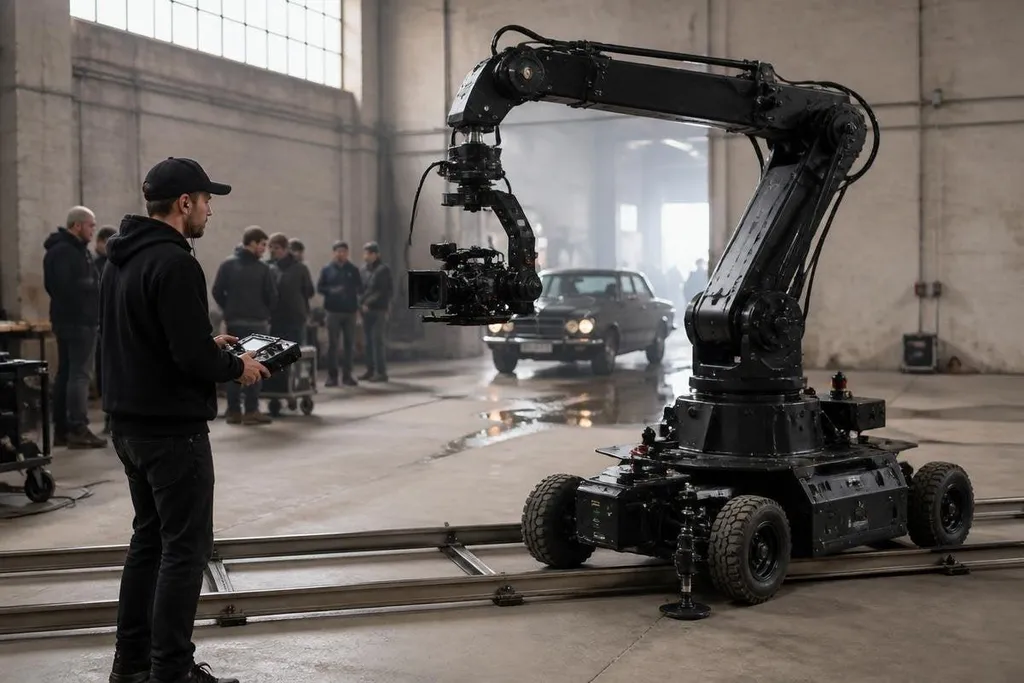
Film production robots are finding useful work where camera movement must repeat exactly, heavy equipment must move safely, or a shot needs more control than a person can give by hand. Their value comes from repeatable motion and careful human control, not from replacing the crew.
Quick read
- Repeatable camera moves can save setup time across several takes
- Remote control keeps people away from moving rigs and heavy loads
- The best jobs are fixed, planned tasks with a clear safety limit
Where robots fit on a film set
A film robot is often a robotic arm, a tracked platform, or a mobile base carrying a camera. The arm moves through programmed points, while the operator sets speed, direction, and timing from a control panel or handheld device.
That makes the robot useful for shots that need the same path again and again. A camera can pass around an actor, move beside a vehicle, or rise through a set while the system repeats the programmed motion for each take.
Repeatability also helps when a scene changes during production. If lighting, props, or actor timing need another take, the camera path can return to the same marks instead of relying on a person to copy the movement from memory.
Why repeatable motion matters
A human camera operator can make small changes during a shot. That skill remains useful for live action and fast changes, while a robot suits a move that needs fixed speed, fixed distance, or a precise stop.
The robot can also link motion to other equipment. A camera move might start when a turntable begins, pause at a set point, or match a programmed light change. The control system needs clear timing signals, and the crew still checks the result on set.
Film work brings a second benefit: the operator can work from a safer position. A remote-controlled arm can move a camera near a vehicle, above a set, or around a difficult angle without placing a person inside the rig's movement area.
A camera arm’s value depends on more than its reach. Producers also need to know how the control system, safety setup, and operator shaped each shot. Film robotics reporting from Robot24.com can place those details beside claims about production robots before the limits become the deciding part.
The limits are easy to see
A robot needs room to move and a stable base. It also needs power and a trained operator.
A crowded set can remove that room quickly, especially when people, cables, lights, and props shift between takes.
Programming also takes time. The crew must set safe speed limits, check the arm's reach, and confirm that the camera and lens stay clear of the set. A short shot may take longer to prepare than it takes to film.
Unplanned action is harder. A person can react to an actor's sudden move or a change in blocking. A programmed robot follows its path until the operator stops it or changes the command.
Cost matters too. The rental price may cover the robot, control gear, transport, setup, and a specialist operator. A production with only a few simple camera moves may get better value from a standard crane, dolly, or handheld rig.
A practical buying and rental check
Before choosing a film production robot, check these points:
- Map the shot: mark the camera path, start point, end point, and nearby people.
- Check the load: include the camera, lens, focus motor, monitor, cable, and any added gear.
- Test the reach: confirm that the arm or base can reach the shot without working at its limit.
- Plan the stop: set an emergency stop that the operator and nearby crew can reach.
- Price the full setup: include transport, rigging, programming, crew time, and changes between takes.
What happens next
Film robots will become more useful as crews build repeatable tasks around them. The practical gains will come from faster setup, safer remote operation, and motion that can be saved and run again when the scene changes.
I'd choose one for a production with repeated camera paths or heavy camera moves. For loose, fast blocking, a human-operated rig still makes more sense. The deciding question is simple: how much of the shot can the crew define before filming starts?